 Club ↗
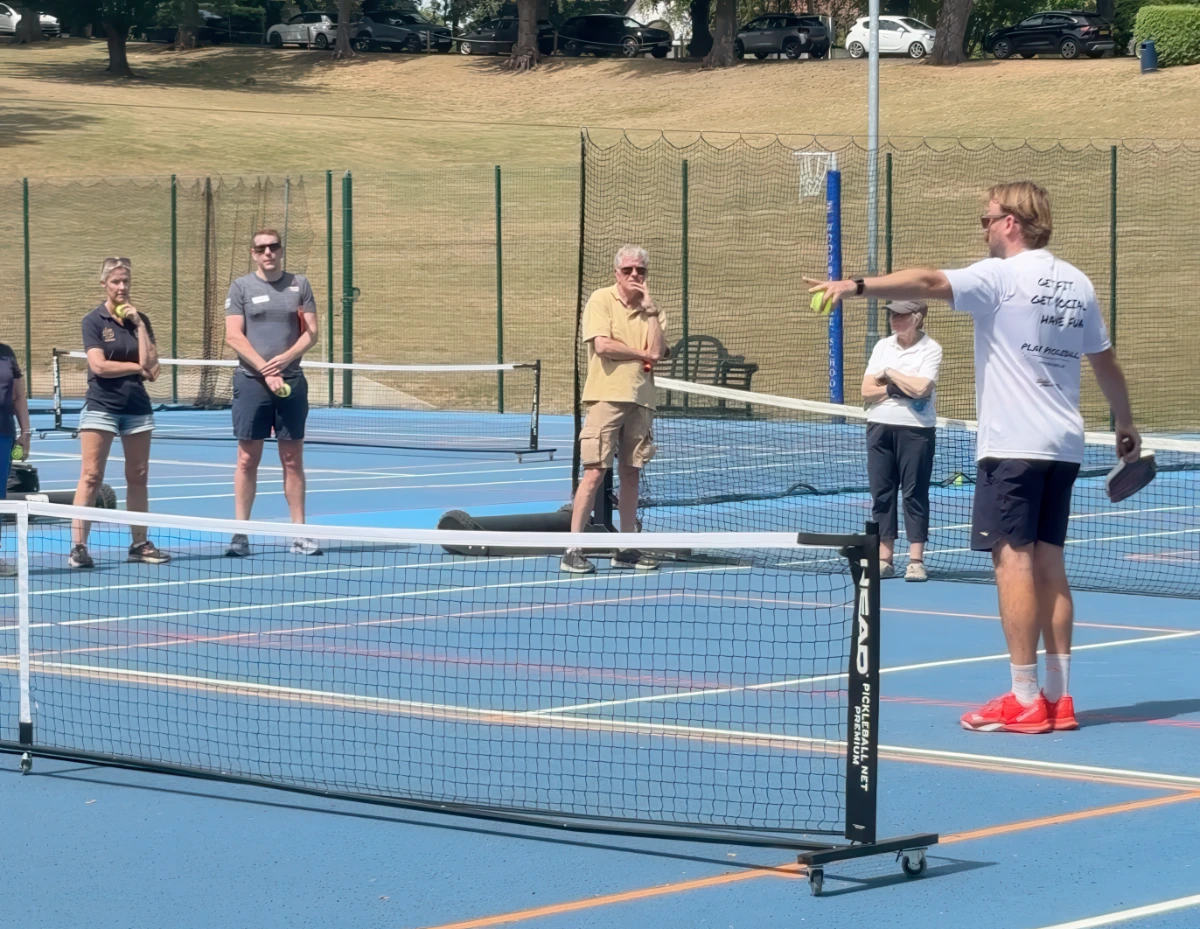
So you've heard about pickleball. Maybe a friend won't stop going on about it, maybe you spotted a court at a sports centre, or maybe you've seen it cropping up on TV and thought — what on earth is that? Whatever brought you here, you're in exactly the right place.
This guide covers everything a complete beginner needs to know — what pickleball actually is, how to play, what the rules are, what to wear, what to expect from your first session, and where to find a game near you. By the time you've finished reading, you'll feel more than ready to give it a go.
1. What Is Pickleball?
In one sentence: pickleball is a paddle sport that combines elements of tennis, badminton and table tennis, played on a compact court with a perforated plastic ball.
You use a solid paddle (not a racket with strings) to hit the ball back and forth over a low net. It's fast enough to get your heart pumping, strategic enough to keep your brain engaged, and — this is the bit people don't expect — surprisingly easy to pick up from day one.
But for now, let's get you ready to play.
2. Why Pickleball Is Perfect for Beginners
Here's something you'll notice the moment you step on court: pickleball doesn't feel overwhelming. Unlike tennis, where the court feels enormous and the serve alone can take months to master, pickleball is designed in a way that gets beginners into a proper rally within minutes.
Here's why it clicks so quickly:
The court is smaller. A pickleball court is roughly the same size as a badminton court — about 6.1m × 13.4m. That means less ground to cover, fewer wild sprints, and a much shorter gap between "I've never played before" and "I actually got a rally going."
The ball moves slower than you'd expect. The perforated plastic ball doesn't fly at speed the way a tennis ball does. There's more time to react, think, and get into position — which is a huge relief when you're learning.
The serve is straightforward. You serve underhand. That's it. No complicated throwing-the-ball-up and swinging with full force. Anyone can serve from their first attempt.
It's inherently social. Most pickleball is played as doubles — two players on each side. That means you've got a partner alongside you, and the game naturally encourages chatter, laughter and teamwork. Sessions tend to have a wonderful atmosphere — competitive enough to be engaging, relaxed enough that nobody minds the odd mishit.
It suits all ages and fitness levels. You don't need to be a former athlete. You don't need to be quick on your feet. The game rewards placement, patience and reading the game more than raw power or speed.
3. The Basic Rules You Need to Know
Don't worry — you don't need to memorise the rulebook before your first session. But here's a solid grounding in the essentials.
Serving
- The serve must be hit underhand — your paddle must make contact with the ball below your waist.
- You serve diagonally across the court, into the opposite service box.
- You must stand behind the baseline (the back line of the court) when you serve.
- If your serve lands in the kitchen (see below), it's a fault.
The Kitchen / Non-Volley Zone
The "kitchen" is the area within 2.1 metres of the net on each side. It's also called the non-volley zone (NVZ), and it's one of the most distinctive features of pickleball.
The rule: you cannot volley the ball while standing in the kitchen (or stepping into it immediately after hitting a volley). A volley means hitting the ball before it bounces.
You *can* enter the kitchen — but only to play a ball that has bounced in there. This rule stops players from just camping at the net and smashing everything. It creates a really interesting tactical dimension once you get into the game.
The Two-Bounce Rule
At the start of each point, the ball must bounce once on each side before either team can start volleying. So:
1. Server serves → receiving team must let it bounce before returning.
2. Serving team must then let the return bounce before they play it.
3. After that, both teams can volley freely (except in the kitchen).
This rule exists to stop the serving side from rushing the net immediately — it levels the playing field nicely.
Scoring
The most common format you'll encounter is side-out scoring (also sometimes called traditional scoring):
- Only the serving side can score points.
- If the serving side wins the rally, they score a point.
- If the receiving side wins the rally, they win the serve (no point awarded — this is called a "side-out").
- Games are typically played to 11 points, and you must win by 2.
In doubles, each player on the serving team gets a chance to serve before the serve passes to the other team (with the exception of the very first service of the game, where only one player serves).
You'll sometimes also hear of rally scoring — where a point is awarded on every rally regardless of who's serving. Some clubs and competition formats use this. If you're playing at a session, just ask which format is being used.
Faults
A fault ends the rally and either gives a point or transfers the serve. Common faults include:
- Serving out of bounds or into the kitchen
- Hitting the ball into the net
- The ball landing out of bounds
- Volleying from the kitchen
- The ball bouncing twice before you play it
4. What Equipment Do You Need?
The good news: paddles and balls are provided at every RallyPoint session, so you don't need to buy a thing before you try it. When you're ready for your own, we sell beginner paddles in our shop.
The Paddle
Pickleball paddles are solid — not strung like a tennis racket or badminton racket. They're typically made from composite materials, graphite or polymer, and come in different weights and grip sizes. As a beginner, any paddle will do — don't worry about specs until you've decided you love the game (you will).
The Ball
Pickleball uses a lightweight, perforated plastic ball — a bit like a Wiffle ball. There are indoor and outdoor versions (outdoor balls have smaller, more numerous holes to reduce wind effects). At RallyPoint sessions, we sort the balls — you don't need to bring your own.
Your Own Kit — When You're Ready
Once you've caught the bug and want to invest in your own gear, you don't need to spend a fortune. A decent beginner paddle costs around £30–£80, and you can be well equipped for under £100.
5. What to Wear and What to Bring
Footwear: Court shoes are ideal — something with lateral support. Tennis shoes or indoor trainers are perfect. Running shoes work fine for casual play, but if you're playing regularly, proper court shoes reduce your risk of ankle rolls.
Clothing: Comfortable sports clothes — whatever you'd wear for a gym session or a casual game of badminton. There's no dress code.
What to bring:
- A water bottle (you'll need it)
- A small towel if you run warm
- Your good mood
What NOT to bring: any anxiety about not knowing the rules. Honestly — every single person at a beginner session was exactly where you are on their first visit. Nobody is judging. People are just happy to have another player on court.
6. What Does a Typical Session Look Like?
Sessions vary by club and format, but here's a rough idea of what to expect at a beginner-friendly RallyPoint session:
Arrival (5–10 minutes before start): Arrive a little early, introduce yourself to the organiser, grab a paddle. Nobody will quiz you on the rules.
Warm-up / introduction: The organiser will typically run a short intro — a quick explanation of the court, the serve, and the key rules. If it's a pure beginner session, this might be a bit longer. If there's a mix of abilities, the more experienced players will show you the ropes on court.
Drills or open play: Depending on the session format, you might do some gentle drills (serving practice, dinking — the soft short game near the net), then move into actual games.
Rotational games: Most sessions use a rotation system so you play with and against different people throughout. This is one of the things that makes pickleball so social — you meet everyone.
End of session: Usually wraps up with a chat, a bit of laughter about memorable shots (or spectacular mishits), and — very often — plans for next week.
You can expect to be on court and actually playing within the first 15–20 minutes of any session, even if you've never held a paddle before.
7. How Quickly Can You Learn Pickleball?
Faster than you'd think.
Most beginners are having genuine rallies — hitting the ball back and forth more than once or twice — within their very first session. Within two or three sessions, most people have a feel for the pace of the game, can serve reliably, and are starting to pick up the kitchen rule.
The deeper tactics — dinking, the third-shot drop, stacking, transition zone play — take longer. But that's the beauty of pickleball: you can have an enjoyable game from session one, and there's always more to learn as you progress. The skill ceiling is surprisingly high once you start exploring it.
8. Frequently Asked Questions
Q: Is pickleball suitable for older players?
Absolutely — in fact, pickleball has become enormously popular with players in their 50s, 60s, 70s and beyond, precisely because it's lower impact than tennis and doesn't demand explosive speed. That said, it's popular across all age groups, and plenty of younger players are getting into it for the tactics and social aspect. Don't let the perception that it's "for older people" put you off — it isn't, and you'll likely find a wide mix of ages at any good session.
Q: Do I need to be fit to play?
Not especially. The court is small, the ball moves at a manageable pace, and you can adjust how much you exert yourself. That said, you'll probably find it more of a workout than you expected — in the best possible way. If you have any health concerns, check with your GP first, as you would with any new sport.
Q: How much does it cost to try pickleball?
Most drop-in sessions in the UK cost between £5 and £10, and equipment is usually provided for beginners. So your first game can cost less than a round at the pub.
Q: Do I need to know the rules before my first session?
No. Read the summary in section 3 above if you like, but most organisers will walk you through everything you need at the start of the session. If you forget something mid-game, just ask — everyone is happy to help.
Q: How do I find a pickleball session near me?
The sport is growing fast in the UK, with sessions popping up in leisure centres, schools, sports halls and outdoor courts across the country. Pickleball England maintains a club finder. If you're in Suffolk or the surrounding area, RallyPoint runs regular sessions — see below.
Q: Can I bring a friend?
Please do. Pickleball is even more fun when you've got someone to play with, and bringing a friend along makes that first session even easier. Most sessions welcome extra players — just check ahead if numbers are capped.
Q: What if I'm a complete beginner but my partner/friend has played before?
That's absolutely fine. A slightly mixed ability group is actually a great way to learn — the more experienced player can demonstrate, and you'll pick things up faster by seeing them in action. Just let the organiser know your situation and they'll make sure you're paired thoughtfully.
9. Where to Play Pickleball in the UK
Pickleball has been growing rapidly across the UK over the past few years. You'll now find sessions in leisure centres, village halls, church halls, school sports facilities and dedicated pickleball clubs in most regions.
In Suffolk, RallyPoint runs regular sessions at Woodbridge School (Burkitt Road, Woodbridge). Sessions cater for all abilities — including complete beginners — with equipment provided and a warm, welcoming atmosphere. Our complete guide to pickleball in Suffolk covers the full local scene.
If you're based in or around Woodbridge, the pickleball in Woodbridge guide covers sessions, the venue and the local community in detail. Coming from Ipswich? The Ipswich pickleball guide has everything you need.
Whether you're in Woodbridge, Ipswich, or anywhere across the Suffolk area, we'd love to see you on court.
Ready to Give It a Go?
RallyPoint runs beginner-friendly sessions in Suffolk — paddles provided, no experience required — just book your place in advance and come and have fun. Book your place at RallyPoint.
Your first session might just be the start of something brilliant.